Artificial Intelligence (AI) tools are rapidly becoming part of everyday business operations. Staff are using AI to draft emails, prepare reports, analyse data, create marketing content, and improve productivity. While the benefits are significant, many SME businesses have adopted AI without establishing any guidelines around its use.
An AI policy does not need to be complicated, but it should provide clear direction on how AI can be used safely and responsibly within your business.
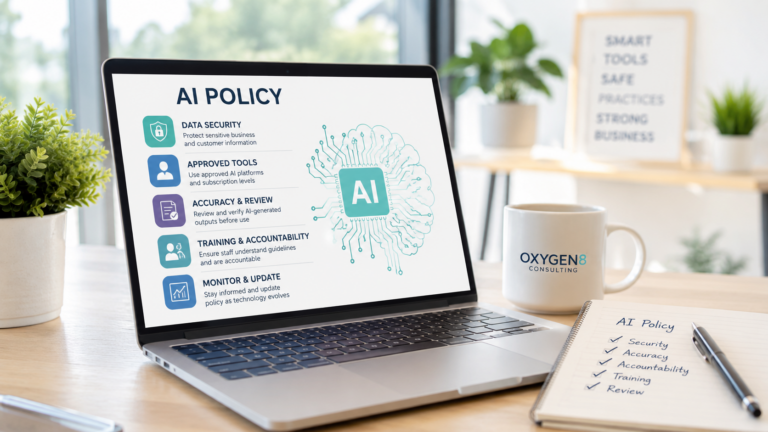
The first consideration is data security. Employees should never enter confidential customer information, financial data, employee records, pricing information, or commercially sensitive material into public AI tools without approval. Once information leaves your systems, you may have limited control over how it is stored, processed, or protected.
The second consideration is choosing the right subscription level. Most AI providers offer both free and paid versions. Free versions may be suitable for personal experimentation, but businesses should carefully review the security, privacy, and administrative controls available. Paid business subscriptions typically provide stronger data protection, user management, and better control over how company information is handled.
The major AI platforms currently used by businesses include:
- ChatGPT from OpenAI
- Gemini from Google
- Claude from Anthropic
- Copilot from Microsoft
Each platform has different strengths and varying levels of integration with existing business software. For example, Microsoft Copilot may be attractive for businesses heavily invested in Microsoft 365, while Gemini offers strong integration with Google’s ecosystem. ChatGPT and Claude are often favoured for content creation, analysis, and general business problem-solving.
Your policy should also address accuracy and accountability. AI-generated content can contain errors, outdated information, or incorrect assumptions. Employees should be required to review and verify all AI-generated outputs before they are used externally or relied upon for business decisions.
Consider defining:
- Approved AI platforms and subscription levels
- Types of information that may and may not be entered into AI systems
- Approval requirements for customer-facing content
- Responsibility for reviewing AI-generated outputs
- Training requirements for staff
- Processes for monitoring new AI tools and developments
The reality is that AI adoption is no longer a future issue—it is already happening in most workplaces. Businesses that proactively establish clear guidelines will be better positioned to capture the productivity benefits while managing the associated risks.
A simple AI policy today could prevent a significant security, privacy, or reputational issue tomorrow.
Written with the assistance of ChatGPT.